

The TradeLocker API, and why trade copying depends on it
TradeLocker has no Expert Advisors, so copying runs on its official API instead. What that means for speed, credentials and what can go wrong.
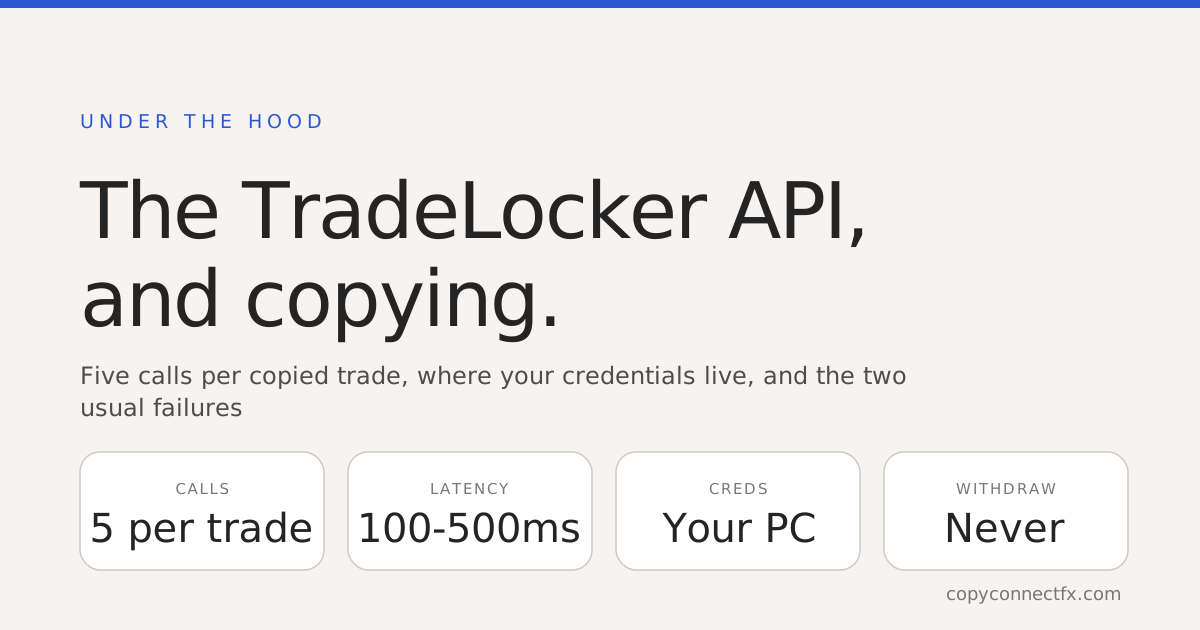
Short answer: TradeLocker's official API is the only supported way to automate anything on the platform, because there are no Expert Advisors to do it from the inside. Every TradeLocker copier, ours included, is a program somewhere else making authenticated API calls.
What the API actually has to do
Copying a trade sounds like one action but is several, and each is a separate call:
- Authenticate to the account and receive a token.
- Read the instruments that account can trade, so a symbol can be resolved to the identifier TradeLocker uses.
- Place the order with a size, a side and optionally a stop loss and take profit.
- Find the resulting position, so later changes can be applied to the right one.
- Modify or close it when the master account's trade changes or ends.
Step 4 is the one that is easy to underestimate. Placing an order and knowing which position it became are different things, and a copier that loses track there cannot mirror a later stop-loss change or a close.
Why speed is what it is
Each of those steps is a request across the internet. That is the entire reason copying to TradeLocker takes 100 to 500 milliseconds while MetaTrader-to-MetaTrader copying on one machine takes under ten. It is distance, not inefficiency, and no amount of local tuning changes it.
What can be tuned is everything before the request. Reading the master's trades from a local file is cheap and happens several times a second; the API call is the slow part and only happens when something actually changed.
Credentials, plainly
To act on your account, the program needs to authenticate as you. In our bridge your TradeLocker login lives in a configuration file on your own computer and goes only to TradeLocker. The program never contacts CopyConnectFX — our address appears in it exactly once, in the user-agent string it uses to identify itself.
That is worth understanding rather than taking on trust, because it also explains a limitation: since the bridge reports nothing back to us, we cannot see whether it is running for you. The log file beside the program is the single source of truth about what it is doing.
The two failures you are most likely to meet
The instrument does not exist under that name. Your broker says XAUUSD.r, TradeLocker says GOLD. A copier should refuse rather than guess at a near match, and ours logs that it could not find the instrument. One line of symbol mapping fixes it.
The size is below the account minimum. Refusing is the right behaviour here too. Rounding a size up to reach the minimum can mean several times the risk that was intended, which is never a good way to resolve a sizing problem.
Where to go next
- MT5 to TradeLocker copier — the bridge built on this API, free
- TradeLocker copy trading end to end — what runs where
- Can you copy trade on TradeLocker? — the platform's limits
- Local versus cloud copying — why where it runs decides the speed
Trading foreign exchange and CFDs carries a high risk of losing money. An API places orders faster and more consistently than you can by hand; it does not improve the decisions behind them.
Frequently asked questions
Does TradeLocker have an API?+
Yes. TradeLocker publishes an official API that can authenticate to an account, read its instruments and positions, and place, modify and close orders. It is the only supported route for automation, because the platform has no Expert Advisors.
Where are my TradeLocker credentials stored when I use a copier?+
In our bridge they sit in a configuration file on your own computer and are sent only to TradeLocker, to authenticate. The program makes no calls to CopyConnectFX at all — our domain appears in it exactly once, inside the user-agent string it identifies itself with.
Why is API copying slower than MetaTrader to MetaTrader?+
Because it crosses the internet. A local MT-to-MT copy never leaves the machine and lands in under ten milliseconds. An API copy is a request to TradeLocker's servers and back, so 100 to 500 milliseconds is realistic depending on distance.
What happens if the API rejects an order?+
The reason is written to the log and the trade is not retried blindly. The common causes are an instrument TradeLocker names differently from your broker, and a size below the minimum that account accepts. Both are visible in the log rather than silent.
Can the API withdraw money from my account?+
The operations a copier needs are authentication, reading instruments and positions, and placing or closing orders. Moving money is not part of copying and our bridge never attempts it. Your funds stay with your broker throughout.
Keep reading
Copy trades between MT4 & MT5 in milliseconds
Free local trade copier with a realtime web dashboard. Set up in 10 minutes — no coding.
Get Started Free