
Prop Firm Drawdown Rules Explained: Daily Loss vs Max vs Trailing
Daily loss limit, maximum drawdown and trailing drawdown are three different rules that break funded accounts in three different ways.
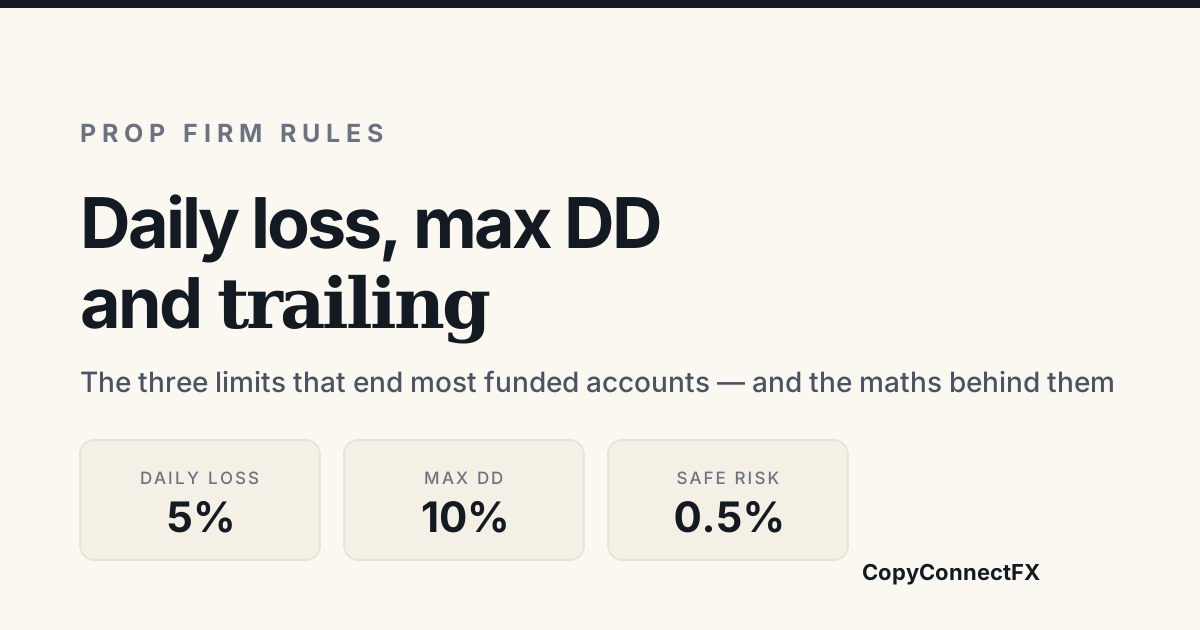
Short answer: prop firms usually enforce three separate limits — a daily loss limit that resets every day, a maximum drawdown that never resets, and in many cases a trailing version of the maximum that follows your equity high upward. Breaching any one of them ends the account. Work out your own numbers in the free prop firm drawdown calculator.
Most funded accounts are not lost to a bad strategy. They are lost because the trader understood one rule and not the interaction between all three. This guide separates them.
Rule 1: the daily loss limit
The daily loss limit caps how much you may lose between the firm's daily reset times — often 00:00 server time, but not always.
Typical value: 4% to 5% of the starting balance.
Two details decide how dangerous it is:
- Balance or equity? If the limit is measured on equity, an open trade sitting at −4.5% has already almost breached it, even though you have not closed anything. If it is measured on end-of-day balance, floating losses do not count until they are realised.
- Measured from what? Some firms measure from the day's starting balance, others from the higher of starting balance and starting equity. On an account carrying open profit overnight these give different floors.
Worked example, $100,000 account with a 5% daily limit measured on equity from the day's opening balance: your floor for the day is $95,000 in equity. Three trades each losing 1.5% take you to $95,500 — still alive, but a fourth trade of the same size ends the account before it can be closed manually.
Rule 2: maximum drawdown (static)
The maximum drawdown is the absolute floor for the life of the account, measured from the starting balance.
Typical value: 8% to 12% of the starting balance.
On a $100,000 account with a 10% static maximum, the floor is $90,000 and it stays at $90,000 whether the account grows to $130,000 or never leaves $100,000. This is the friendliest version of the rule: profit is genuinely yours, and it buys you room.
Rule 3: trailing drawdown
A trailing maximum follows your account upward. The floor is recalculated from the highest point the account has reached, not from where it started.
Same $100,000 account, 10% trailing:
| Account peak | Floor | Room from peak |
|---|---|---|
| $100,000 | $90,000 | $10,000 |
| $104,000 | $93,600 | $10,400 |
| $110,000 | $99,000 | $11,000 |
The trap is what happens after a good run. Take the account to $110,000, and the floor is now $99,000 — above your starting balance. A drawdown that would have been perfectly survivable on day one now ends a profitable account.
Two variations matter enormously and are easy to miss in a rulebook:
- Does it trail on balance or on equity? An equity trail moves the floor up on unrealised profit — so a trade that goes 3% in your favour and comes back to breakeven has permanently raised your floor.
- Does it stop trailing? Many firms freeze the trail once the account is up by the drawdown amount (at $110,000 on a 10% rule, the floor locks at $100,000). Some never freeze it. This one clause is worth more than any strategy tweak.
How the three interact
The binding constraint is whichever limit you reach first, and it is not always the one you are watching. On a $100,000 account with a 5% daily and a 10% total limit, two consecutive bad days at −4.9% each keep you inside the daily rule both times, and take you straight through the maximum. Staying inside the daily limit is not the same as being safe.
The practical planning question is: how many consecutive losing trades should this account survive? Answer that first, then divide.
| Daily limit | Losses to survive | Max risk per trade |
|---|---|---|
| 5% | 5 | 1.0% |
| 5% | 10 | 0.5% |
| 4% | 8 | 0.5% |
| 4% | 16 | 0.25% |
Once you have a risk-per-trade figure, our lot size calculator converts it into an actual position size for each trade, and the drawdown calculator shows how many losses each setting survives before the account is gone.
Automating the floor
Arithmetic does not help at 3am when a position is running against you. If you copy trades between accounts, the CopyConnectFX Receiver EA has equity protection built in: set a maximum daily loss percentage or a hard equity floor, and when it is reached the EA closes every copied position, deletes copied pending orders and pauses copying — before the firm's own limit is touched. Set your figure slightly tighter than the firm's, so that your software trips before their rule does.
Copying between your own accounts is allowed by most firms, but not all, and the terms change. Read your own agreement — our guide to using a trade copier on funded accounts covers what to look for, but your firm's rulebook is the only authority that matters.
Check where you actually stand
Rules are theoretical until you measure your own history against them. Run your MetaTrader report through the free statement analyzer and look at your worst day and your maximum drawdown as a percentage. If your historical worst day is bigger than the firm's daily limit, the strategy has already failed the challenge once — it just did it on an account with no rules attached.
Try the calculator
The prop firm drawdown calculator is free and runs in your browser. Enter your account size, the firm's daily and maximum limits, and whether the drawdown trails — it returns your live floor, your room to the next limit, and how many consecutive losses each risk setting survives.
Frequently asked questions
What is the difference between daily drawdown and maximum drawdown?+
Daily drawdown is how much you may lose in a single trading day, measured from that day's starting balance or equity and reset at the firm's daily cut-off. Maximum drawdown is how far the account may fall from its starting balance — or from its highest point, if the drawdown trails — across the entire life of the account, and it never resets.
What is trailing drawdown?+
Trailing drawdown means the loss limit follows your account upwards. If the limit is 10% and the account grows from $100,000 to $106,000, the floor rises from $90,000 to $95,400. Most firms stop the trail once the account is in profit by the drawdown amount, but the exact rule varies and it is the single most misread line in any prop-firm rulebook.
Is daily drawdown measured on balance or equity?+
Most firms measure it on equity, which means floating losses on open trades count against you immediately — you can breach the limit without closing a single trade. A minority measure on balance at close. Which one your firm uses changes how you must manage open positions overnight, so check before you trade.
How much can I risk per trade on a funded account?+
Work backwards from the daily limit, not forwards from a habit. If the daily loss limit is 5% and you want to survive five consecutive losers in a day, that is 1% per trade. Wanting to survive ten means 0.5%. The calculation is arithmetic, but the number of consecutive losses you should plan for is a judgement about your own strategy.
Does a trade copier break prop firm rules?+
Copying between your own accounts is permitted by most firms, but many restrict copying identical trades across multiple challenges at the same firm, and some prohibit copying signals from a third party. The rules differ by firm and change often — read your own agreement rather than a general answer, including this one.
Keep reading
Copy trades between MT4 & MT5 in milliseconds
Free local trade copier with a realtime web dashboard. Set up in 10 minutes — no coding.
Get Started Free